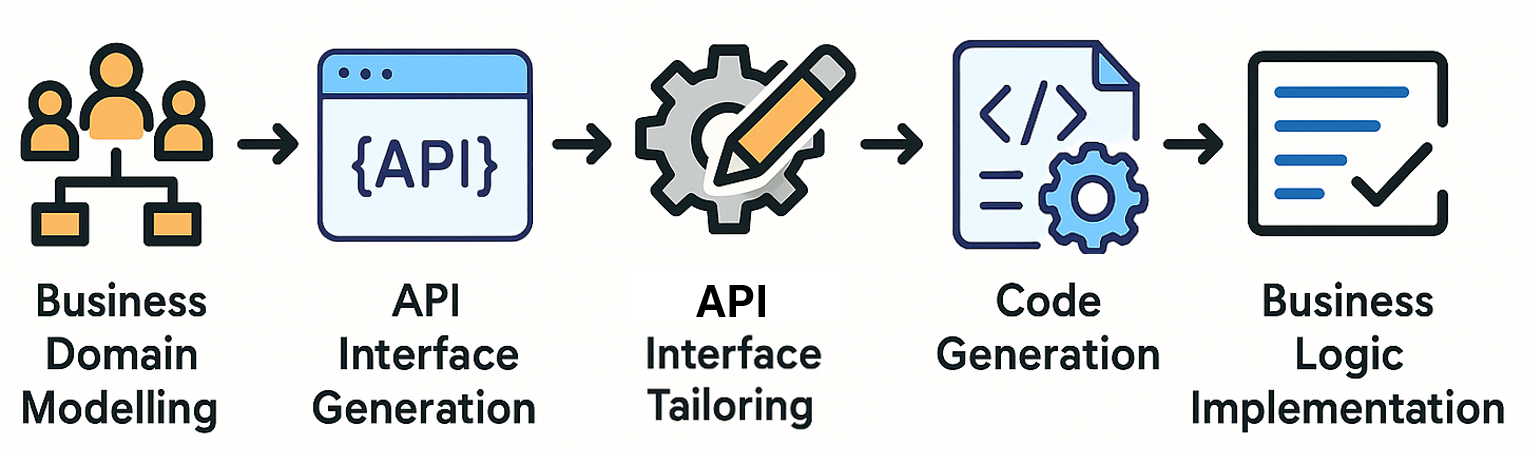
The REST API Generator is a toolset that automates the creation of REST API client interface specifications and skeleton implementation code
from a graphical business domain model.
It enables a contract-first approach for API development, significantly reducing the time and
cost
required to create REST APIs.
API Development Challenges
A best practice for API development is to first define the API's client interface before any API code is written (aka "Contract-first Development"). Key benefits include early alignment of API stakeholder expectations, the ability to create client interface mockups for early feedback and validation of the API's interface design, parallel development of API client integrations and API implementation, improved developer and client collaboration, and reduced risk.
However manually writing an OpenAPI interface specification is a laborious activity. Specifications for non-trivial APIs can easily require thousands of lines of detailed JSON code for specifying API endpoints, request formats, response formats, success/error status codes, and domain model schemas. For example, this API requires 14000 lines of JSON code to implement its OpenAPI specification! For an API of this size experience has shown that a developer typically needs three weeks to manually write the JSON code, test it, and resolve issues. Assuming that the developer can finish the work in three weeks, and given an average developer rate of $60 per hour, the cost to manually write the API's client specification is $7,200!
How does the REST API Generator Save Time and Money?
The REST API Generator provides two important capabilities to greatly reduce API development effort. First it automatically generates the API's OpenAPI specification from a graphical business domain model expressed as a UML class diagram. Second it reads the API's OpenAPI interface specification to automatically generate code implementing the API's skeleton infrastructure.
The following figure illustrates the main steps for quickly designing and implementing robust APIs using the REST API Generator. Click each step for a description of that step's development activities.
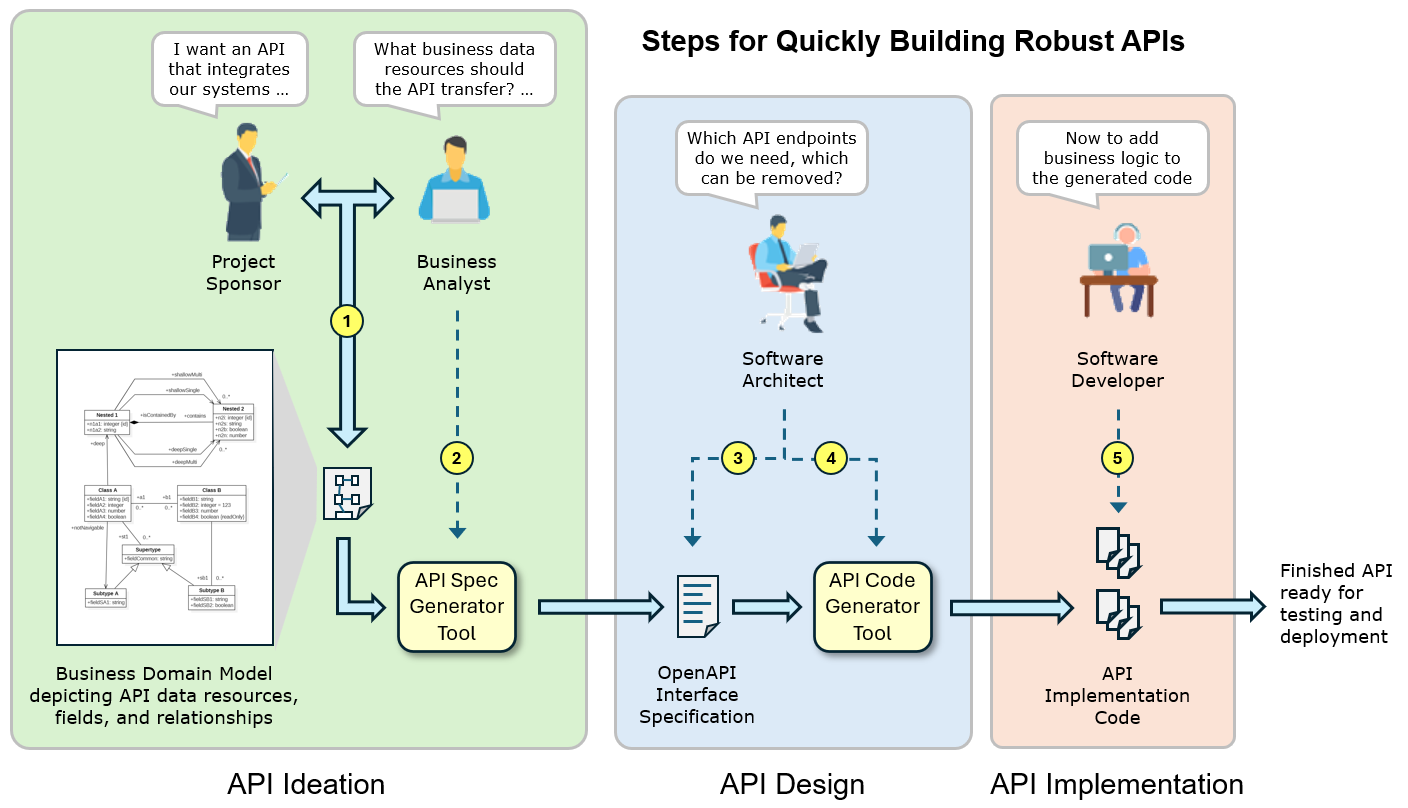
By using the REST API Generator development activities that used to take weeks to perform manually can now be accomplished automatically in a matter of minutes. Instead of developers spending time to manually create API specifications and write API foundational code they can now focus on implementing the API's business logic to more quickly realize the API's business value proposition and shorten time to market.
Try the REST API Generator Risk Free
Would you like to experience how the REST API Generator can help your organization automatically generate REST API specifications and operational API code? You can try the REST API Generator risk free by registering for a free trial license. The trial license provides full access to all REST API Generator features for a period of 24 hours. There is no obligation to continue using the tool after the trial period expires.
To try the REST API Generator you'll need a business domain model created with the StarUML modeling tool. You can either create your own domain model or download a sample domain model. Once you've obtained a business domain model register for a free trial license.
Questions, comments, or suggestions? Contact our sales team at sales@api-excellence.com.
Tools Comprising the REST API Generator Toolset

|
StarUML Modeling Tool - a COTS tool
used by your Business Analyst to create the API's business domain model. Not sure where to begin? We offer consulting services to help you ideate your API's business value proposition and model your business domain resources. Contact sales@api-excellence.com for more information. |
|
API Specification Generator -
generates an OpenAPI client interface specification from the domain model's resource diagram. |
|
API Code Generator - generates
the API's skeleton implementation code (API controllers and model schema DTOs) from the API's client interface specification. |